
Efficiently manage the export of American standard electrical materials on a global basis
Email : sales@americanfalcon.com
Efficiently manage the export of American standard electrical materials on a global basis
Surprising claim: many people who think they use “private” crypto tools are still leaking identifiable metadata at the network and device levels. That matters because privacy is not a single toggle; it is an architecture of choices that spans key custody, transaction design, network routing, device security, and mixing or shielding mechanics. If you care about keeping Monero (XMR) and Bitcoin (BTC) activity unlinkable to you in everyday U.S. contexts—whether for lawful privacy, financial confidentiality, or resisting opportunistic surveillance—you need to compare concrete mechanisms and trade-offs, not slogans.
This article walks through the mechanism-level differences between holding Monero and Bitcoin inside a privacy-focused multi-currency wallet, how in-wallet exchange affects privacy, and what real limits and choices look like in practice. I use a concrete, modern wallet design as the running example to show how features like device-level encryption, Tor routing, mandatory shielding, subaddresses, UTXO control, and hardware wallet pairing interact. If you want a practical next step, the wallet under discussion is available as an option to explore: cake wallet.
Privacy in a wallet isn’t one thing; it’s layered. At the base is key custody: non-custodial design means private keys are never shipped to a server. On many modern devices, wallet data is further protected by device-level encryption and hardware authentication (Secure Enclave on iOS; TPM on Android). That reduces the risk of local extraction, but note the practical boundary condition: strong device security mitigates casual compromise, but a physically seized device or a compromised OS can still expose secrets unless paired with an external hardware wallet.
Up the stack is transaction privacy. Monero uses ring signatures, stealth addresses, and confidential transactions by design, providing strong on-chain unlinkability. A wallet that supports Monero must manage view keys carefully; a highest-standard implementation keeps the private view key on-device and uses subaddresses for per-counterparty routing to avoid address reuse. For Bitcoin, privacy is more of a toolkit: UTXO (unspent transaction output) coin control, PayJoin (mutual transaction blending), Silent Payments, and batching are techniques that reduce traceability but do not make BTC fungible in the same way Monero does. Each technique has specific mechanics and limits—PayJoin requires a cooperative counterparty or compatible service, and coin control requires discipline from the user.
Network-level privacy matters because every transaction needs connectivity. Tor-only modes, I2P proxy support, and custom node connections prevent third parties (including your ISP) from trivially observing which addresses you query or which nodes you talk to. Again, this is a probabilistic defense: Tor reduces IP linkage but can be undermined by misconfigured apps, external metadata leakage, or deanonymizing exit-node activity when the protocol exposes information.
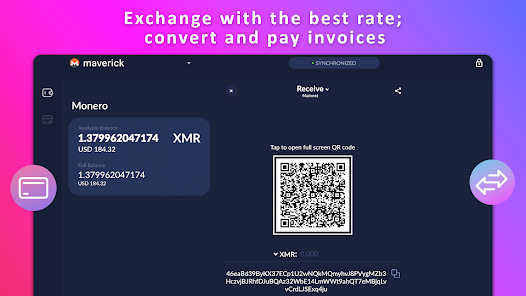
Built-in swapping simplifies moving between BTC, XMR, ETH and other assets without an external exchange. That convenience has a privacy upside: it avoids KYC exchanges and central custodians, and when the wallet routes swaps via decentralized systems (for example, using decentralized routing like NEAR Intents), it reduces single-point linkages. Mechanically, NEAR Intents can orchestrate cross-chain liquidity paths through market makers to find competitive rates without relying on any single custodial counterparty.
However, swaps are not a magic cloak. Each swap involves on-chain activity on the source and destination chains that can carry timing, value, and pattern signals. For Monero-to-Bitcoin swaps, the XMR side benefits from Monero’s unlinkability, but the BTC side may reveal timing and value that could be correlated by a persistent observer. A privacy-conscious workflow therefore combines in-wallet swapping with network privacy (Tor/I2P), optional hardware wallets, and split timing or amount strategies to avoid creating easy cross-chain correlation signals. The trade-off is convenience vs. the tiny friction of manual staging; in hostile environments you should accept extra steps to stitch better privacy guarantees.
Monero’s strengths are innate: all transactions are private by default because stealth addresses and ring signatures are built into the protocol. A wallet that preserves the private view key locally and supports subaddresses preserves those guarantees in practice. The cost is interoperability: many services (exchanges, merchants) do not support Monero as readily, and some compliance-focused jurisdictions treat XMR with extra scrutiny.
Bitcoin gives you modular tools. Silent Payments and PayJoin v2, UTXO coin control, and batching let a disciplined user substantially reduce traceability. But Bitcoin’s base layer is transparent; these measures are mitigations, not protocol-level privacy guarantees. They depend on counterparty support (e.g., for PayJoin), wallet infrastructure, and user behavior. The upside is compatibility and liquidity across U.S. services; the downside is residual linkability and the cognitive load of good operational hygiene.
Pairing software wallets with hardware devices (Ledger, or air-gapped designs such as a dedicated “Cupcake” style device) materially raises the bar against local key extraction and remote malware. The mechanism is simple: the private key never leaves the secure element, and transactions are signed inside the device. For Monero, this means your ring signatures and key images are produced in an environment that an infected phone cannot fake. The trade-off is convenience—air-gapped signing is slower—and for day-to-day small payments some users will accept a software-only flow. In the U.S. context, where theft and device seizure are realistic risks, users need to weigh convenience against physical threat models.
No wallet can fix every privacy leak. Some limits are structural: Bitcoin’s public ledger is never fully private; Monero’s privacy depends on protocol health (e.g., ring size, network participation); and cross-chain swaps create observable anchor events. Other risks are operational: a user who reuses addresses, links on-chain addresses to KYC exchanges, or leaks transaction screenshots on social media undermines even the best wallet architecture.
There are also migration and compatibility quirks that matter in practice. For example, Zcash migration from certain wallets may be incompatible due to different change address handling, requiring manual transfers. These are not theoretical—they reflect how subtle protocol and wallet design differences can force extra, risky steps. Another boundary: zero-telemetry policies and open-source code reduce developer-side risk, but they don’t eliminate the user’s responsibility to secure backups, verify builds, or use trusted distribution channels like F-Droid or official app stores.
Heuristic: align convenience with your adversary. If your primary concern is everyday privacy from advertisers and casual observers, a software wallet with Tor, PayJoin, and careful UTXO control gives a strong balance. If you’re protecting against device seizure, pair with a hardware wallet. If you need the maximum on-chain unlinkability for high-sensitivity transfers, prioritize Monero with subaddresses, retain control of view keys on-device, and use Tor-only routing.
Operational checklist for U.S. privacy-conscious users: enable device hardware protection (Secure Enclave/TPM), use a 4–6 digit PIN plus biometrics where available, run the wallet via Tor or I2P, avoid address reuse by using subaddresses or fresh BTC outputs, prefer in-wallet decentralized swaps rather than KYC exchanges when possible, and keep the private view key local for Monero. Finally, test and validate any hardware integration—mispaired devices or improper backups are a common failure mode.
No. In-wallet swaps reduce some risks by avoiding centralized exchanges and routing via decentralized intents, but the on-chain events on each blockchain remain observable. Combine swaps with network privacy (Tor/I2P), staggered timings, and amount-splitting strategies to minimize cross-chain correlation.
Not always. Monero provides stronger default fungibility and unlinkability on-chain, but Bitcoin offers broader acceptance and modular privacy tools. Choice depends on your need for interoperability versus absolute on-chain privacy, and on practical factors like merchant support, regulatory signals, and personal operational discipline.
Network privacy is essential. Even with private transactions, IP addresses and node queries can create linkage. Tor or I2P significantly reduces the ability of third parties to associate network activity with your identity, though misconfiguration and metadata leaks remain possible.
Yes, if your threat model includes physical device compromise or sophisticated remote attacks. Hardware wallets keep signing keys isolated; the trade-off is convenience and sometimes additional setup complexity for features like subaddress management.
What to watch next: the technical signals that change trade-offs are subtle but visible. Wider PayJoin adoption and wallet-enforced batching would shrink Bitcoin traceability; improved decentralized swap routing reduces reliance on single market makers; and any shift in regulatory treatment of privacy coins could affect service support in U.S. exchanges. Each of those would change operational best practices—so treat your wallet configuration as a tactical choice to review periodically, not a one-time selection.
Bottom line: privacy is a system, not a feature. The wallet you choose and the way you configure it can make the difference between plausible deniability and a tidy data trail. Understand the mechanisms, accept the trade-offs, and pick the layered defenses that match the real adversary you worry about.

Leave a comment